In a nutshell
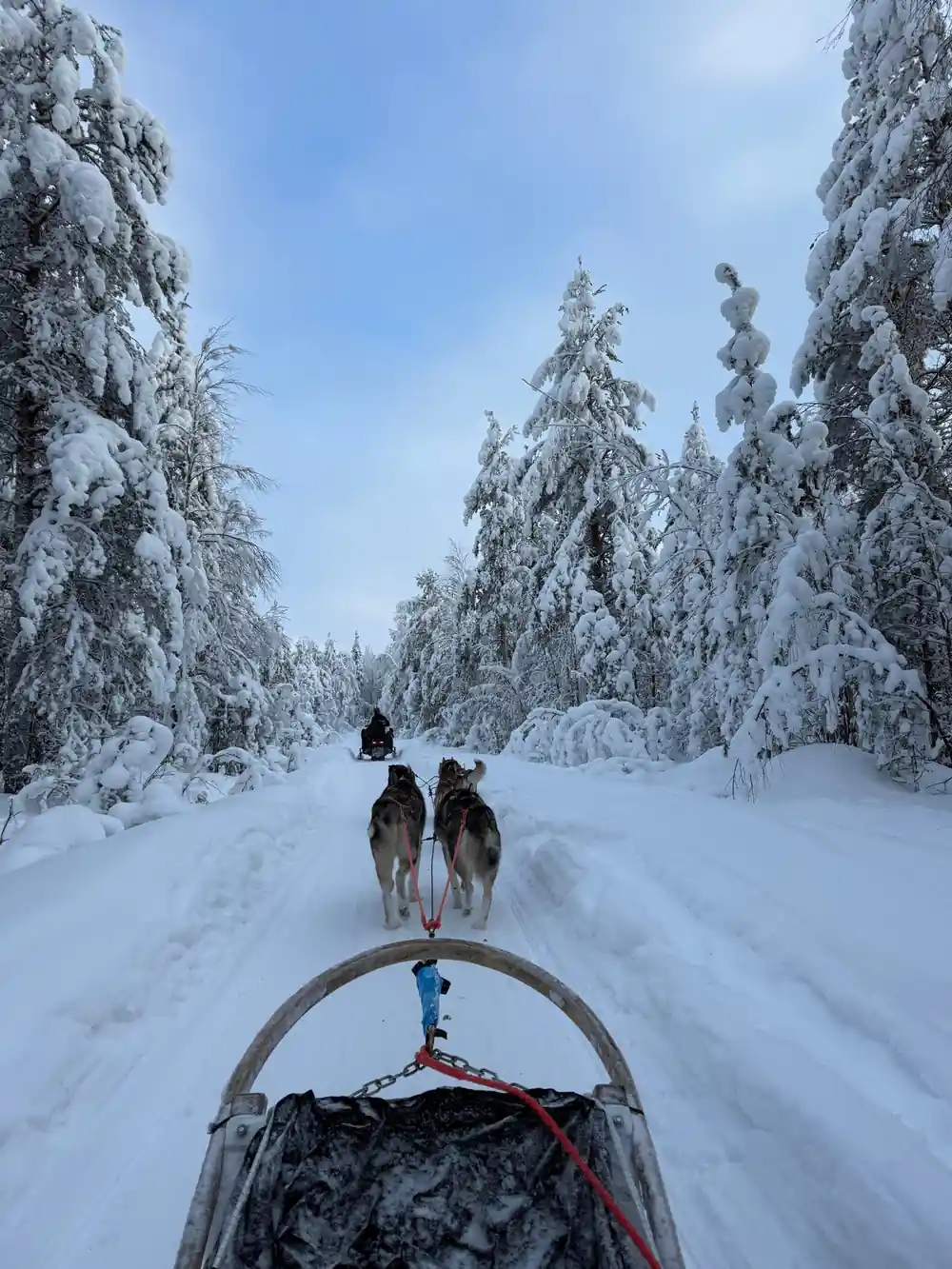
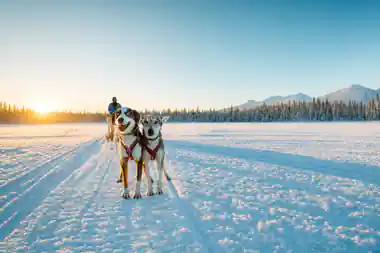
- Your team crosses snow forest thick with tykky spruce, then opens onto frozen lake ice before returning through Arctic silence. Six kilometres total.
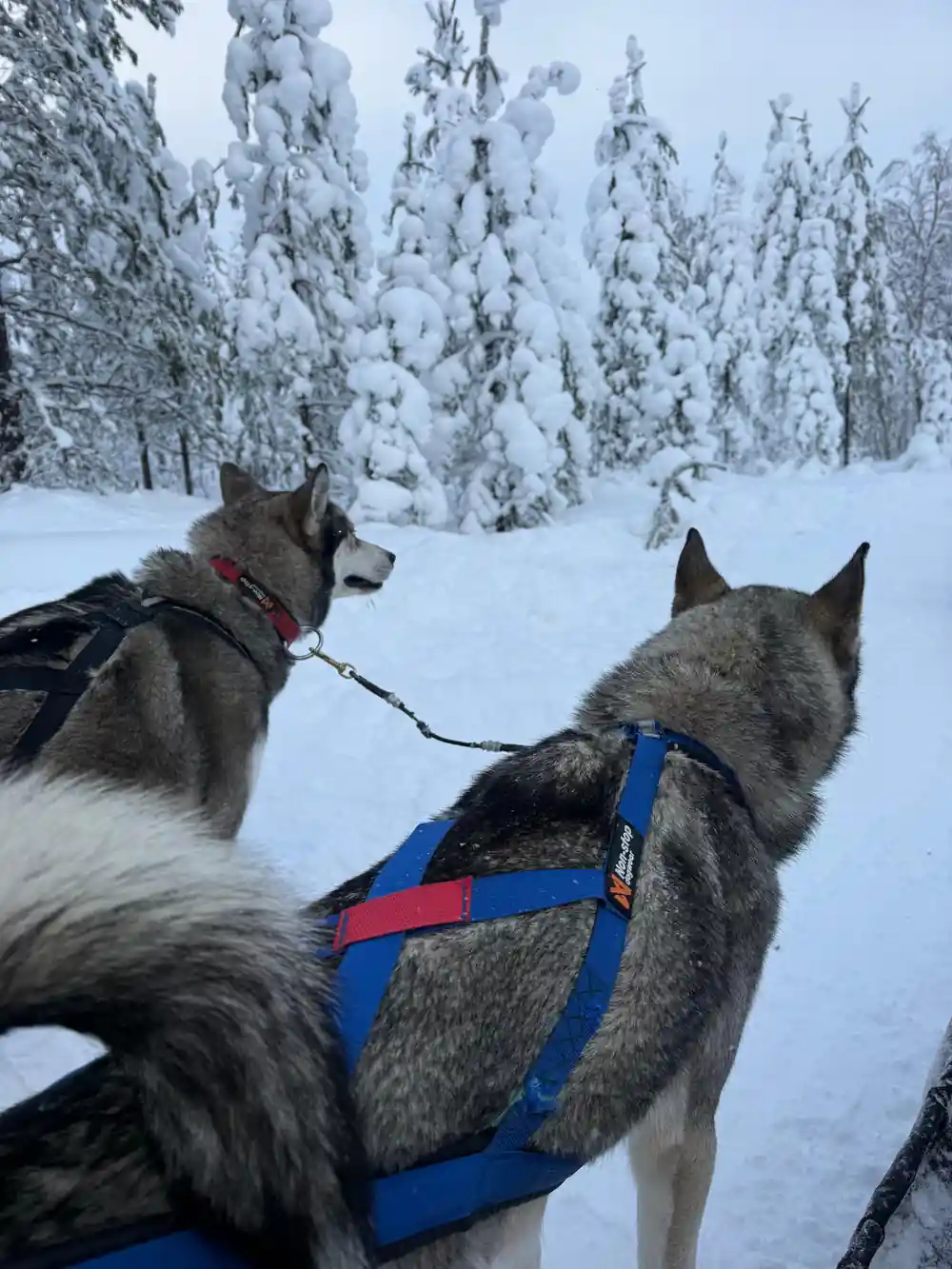
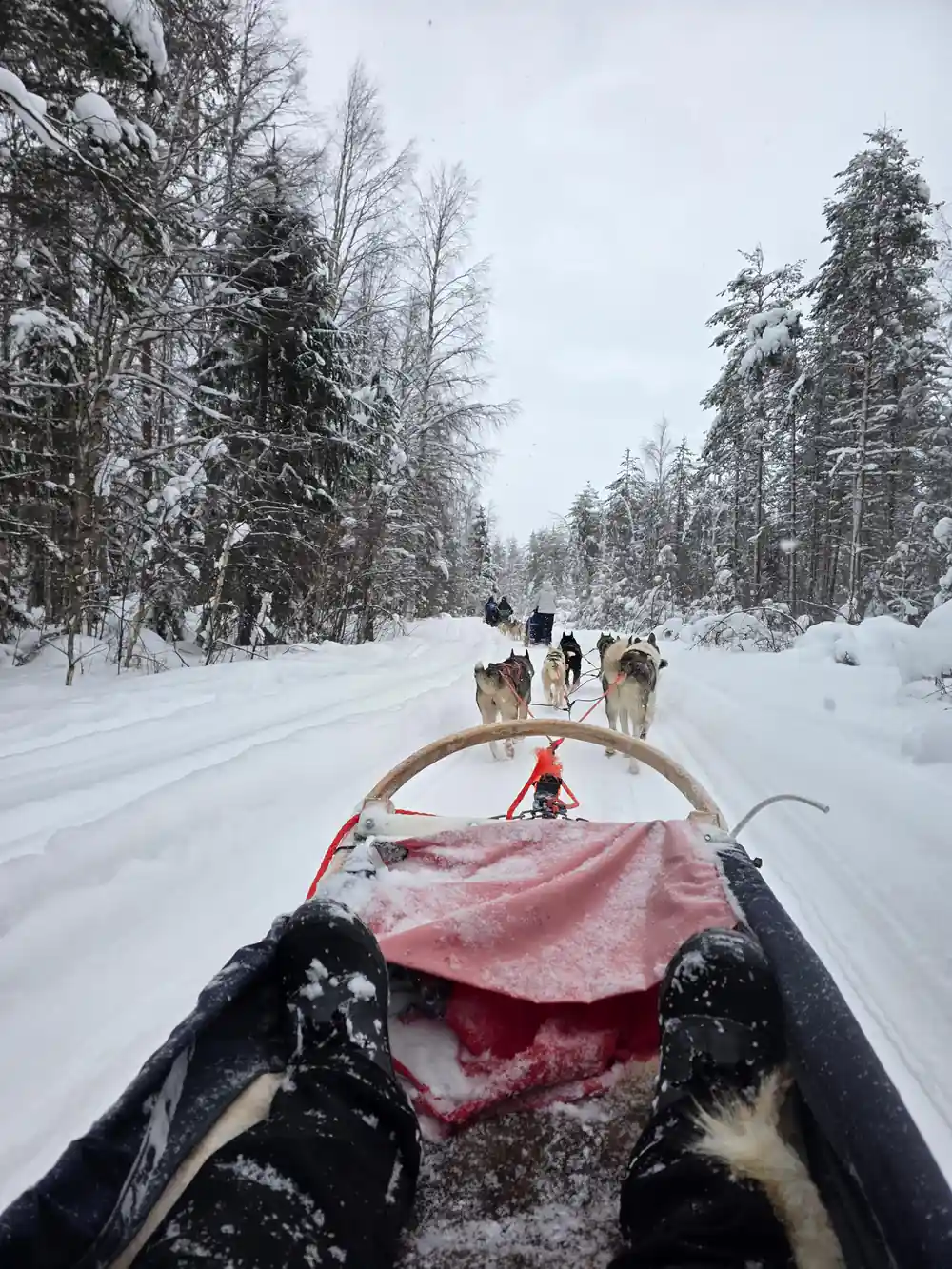
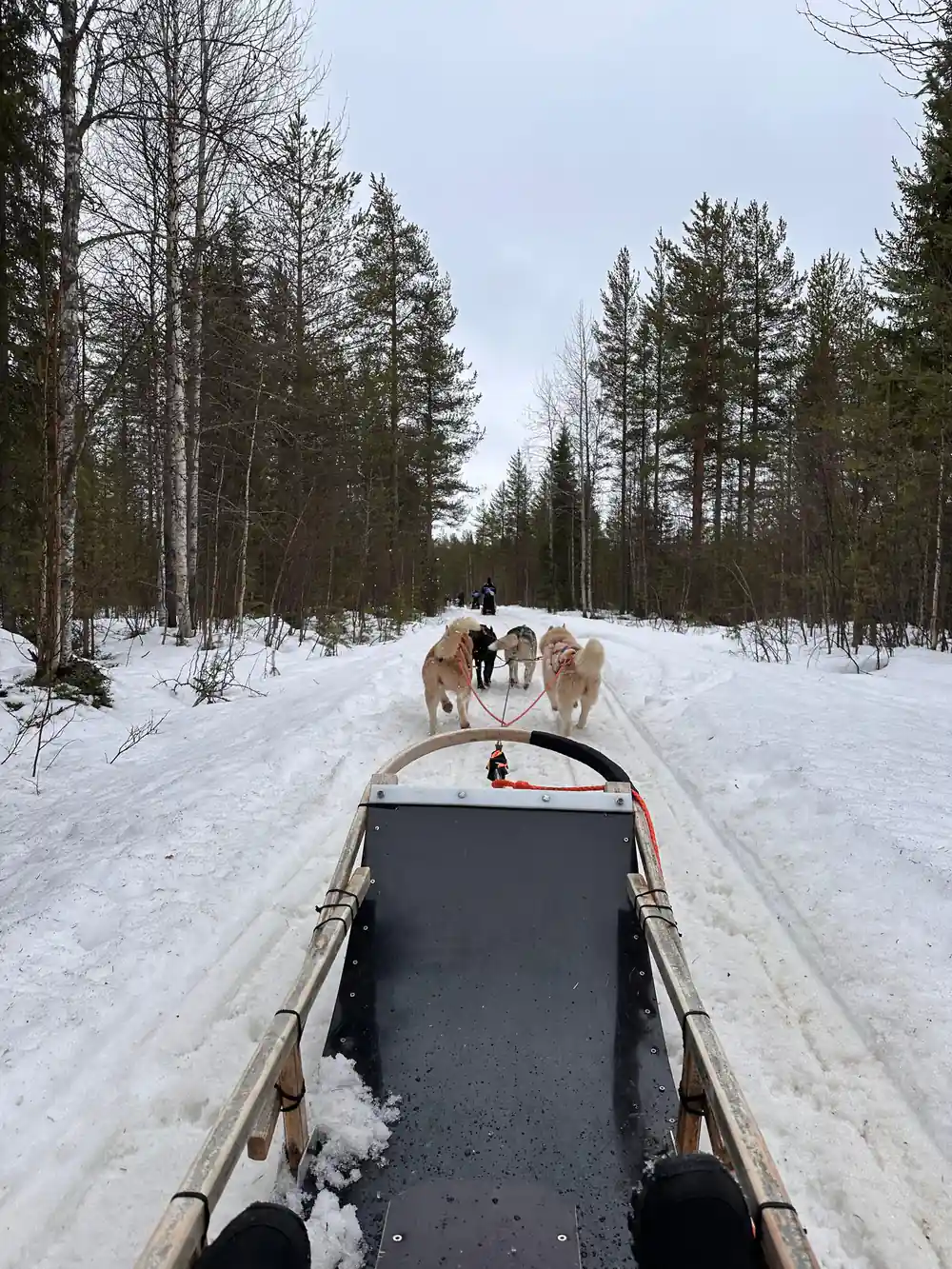
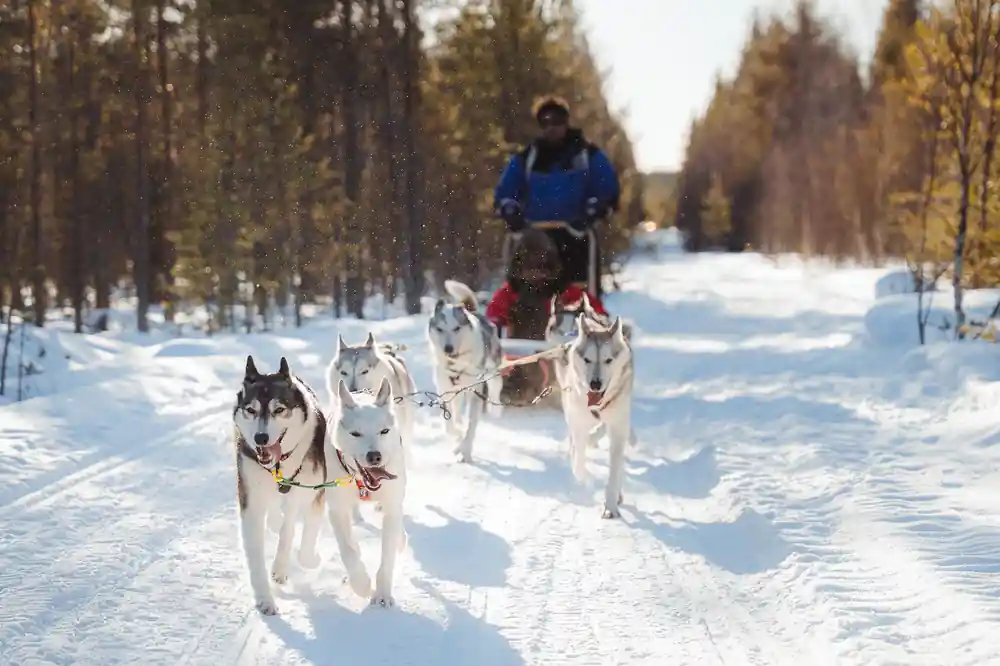
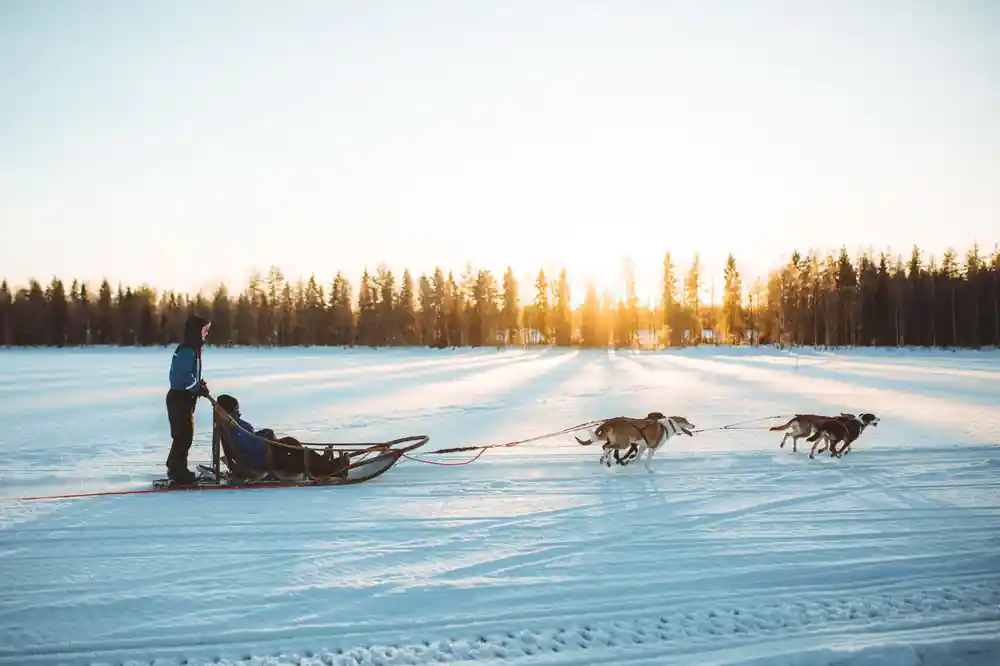
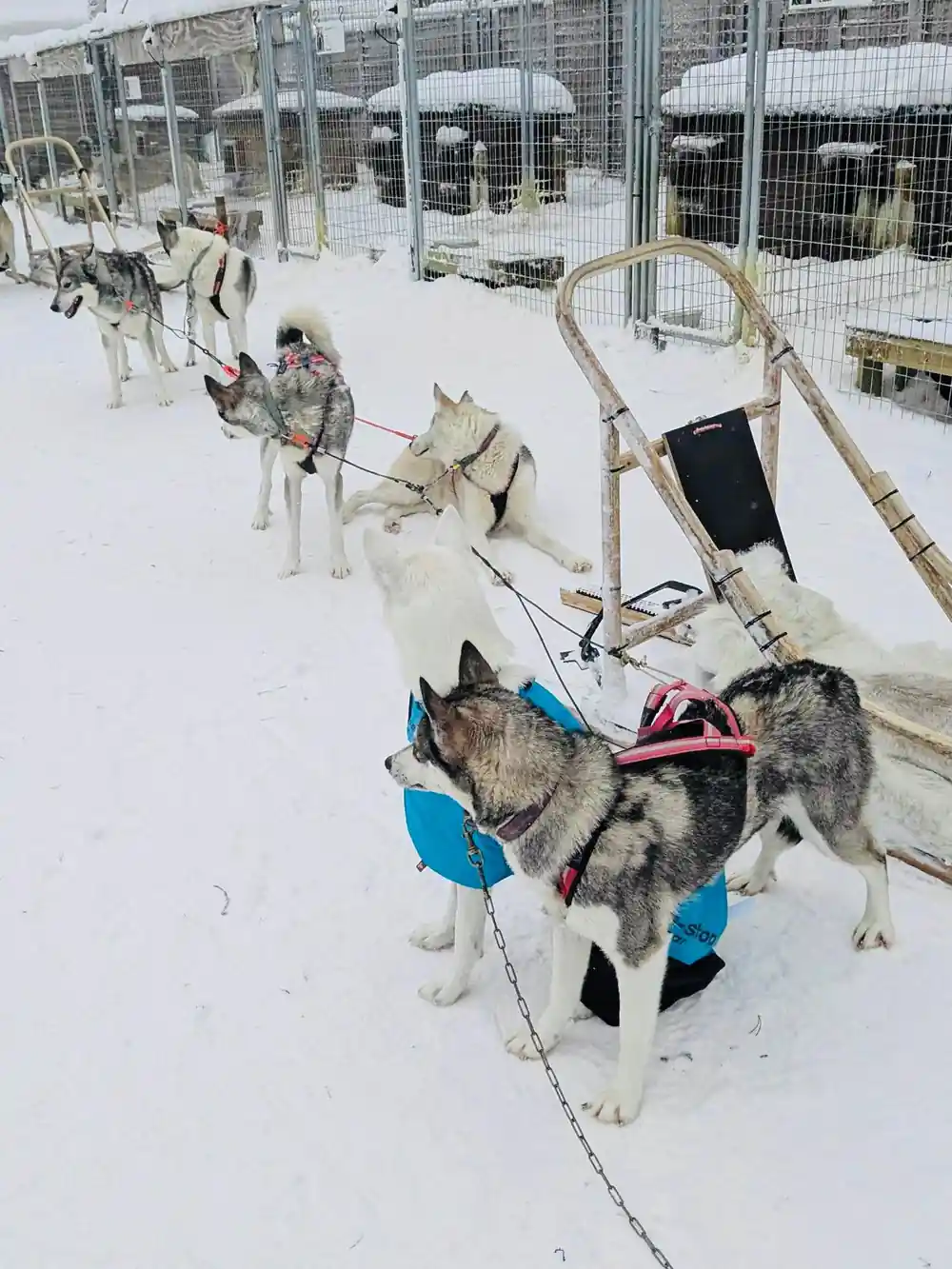
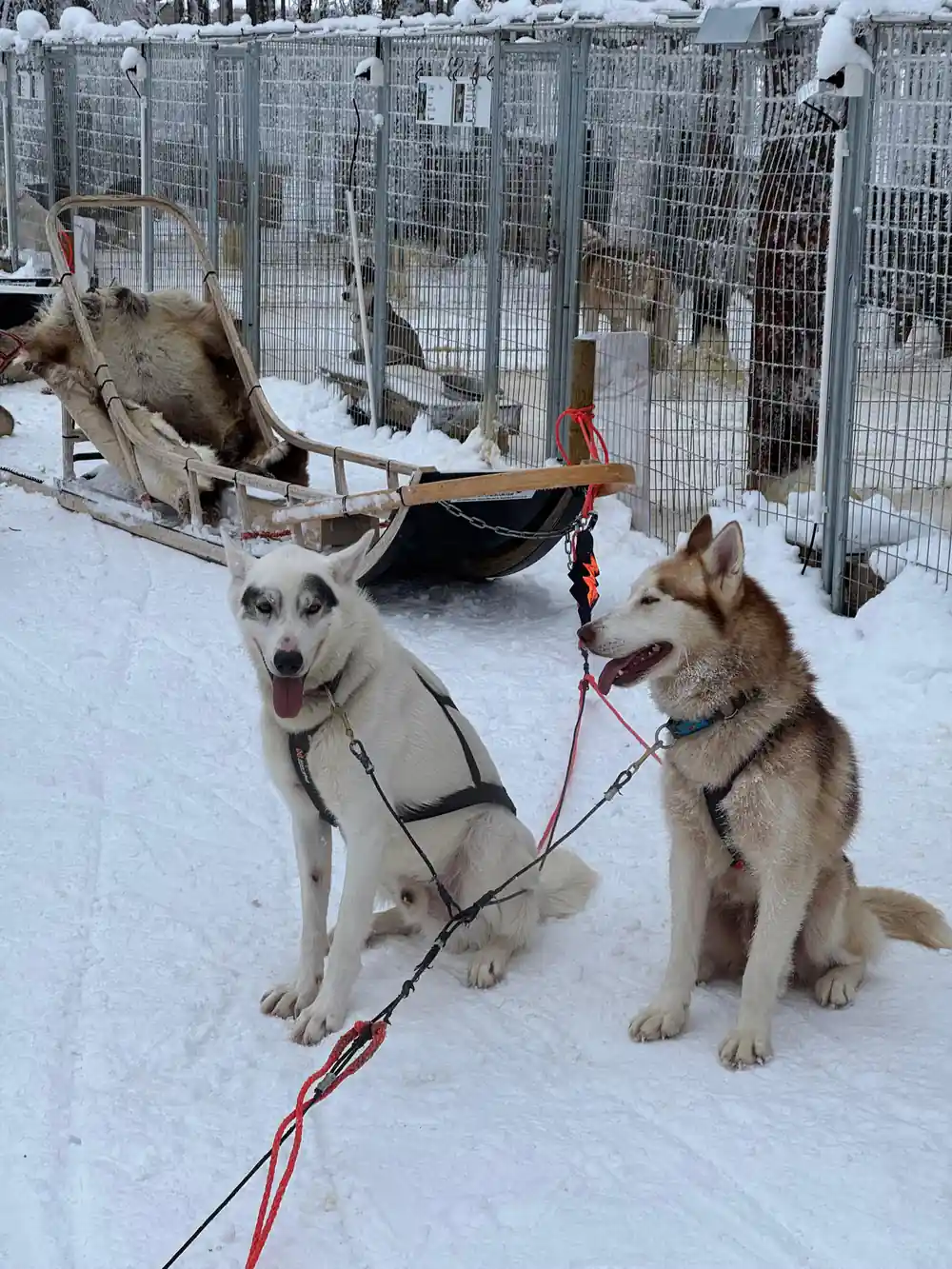
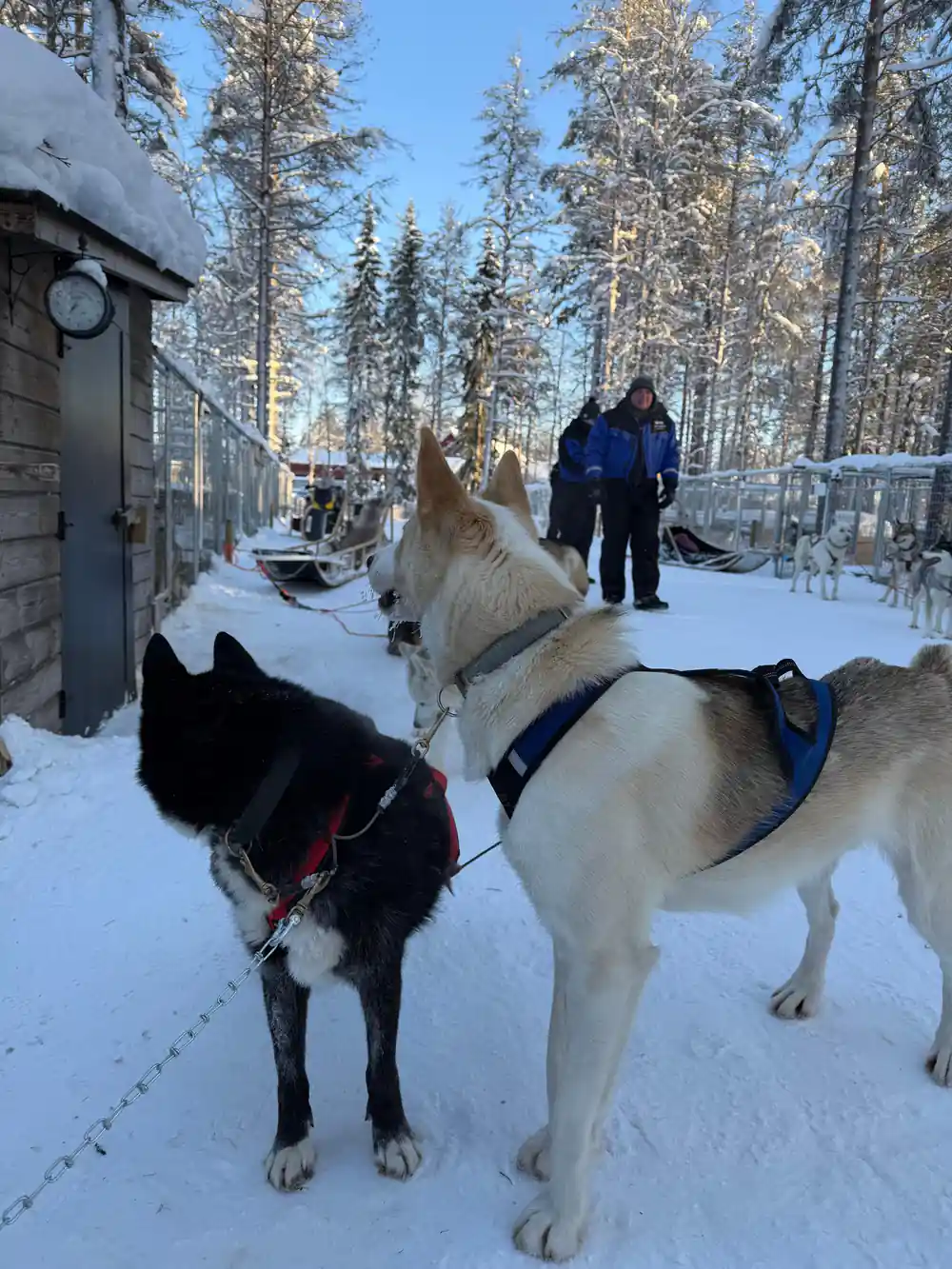
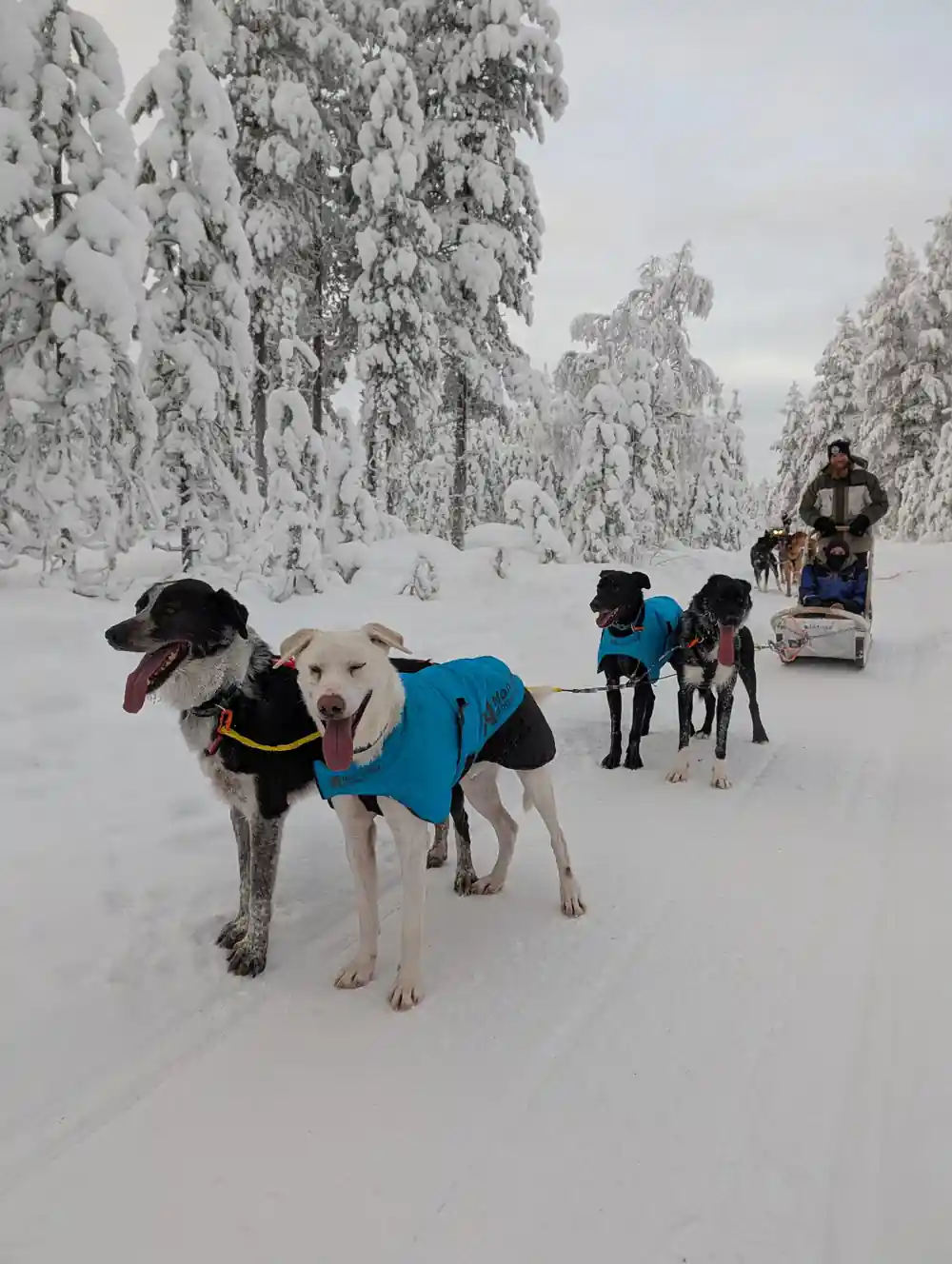
- A six-dog husky team travels at a steady pace across the trail. The entire sledding adventure lasts three and a half hours from start to finish.
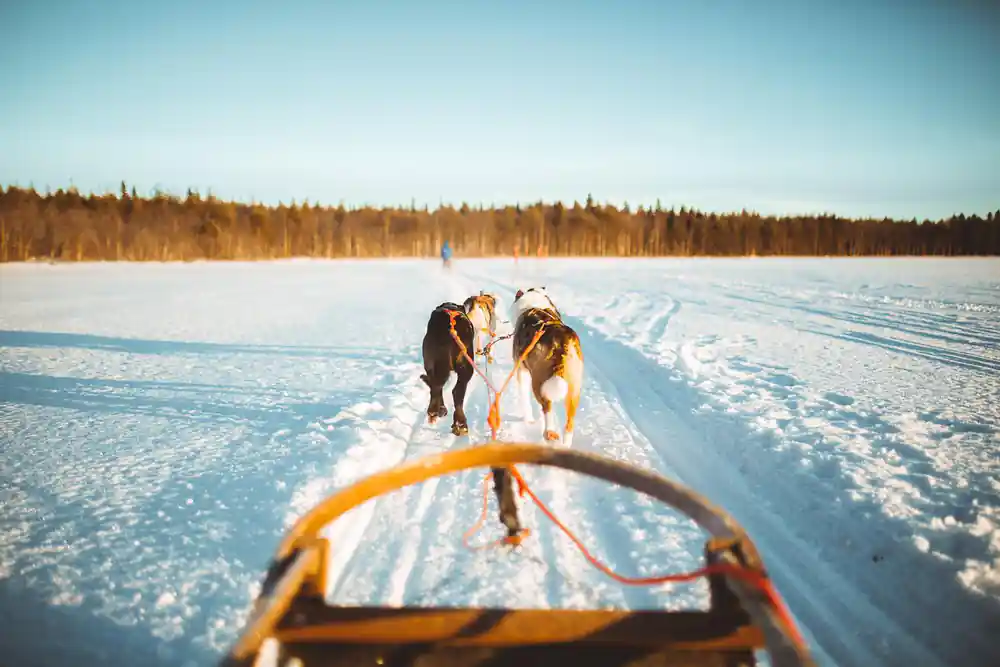
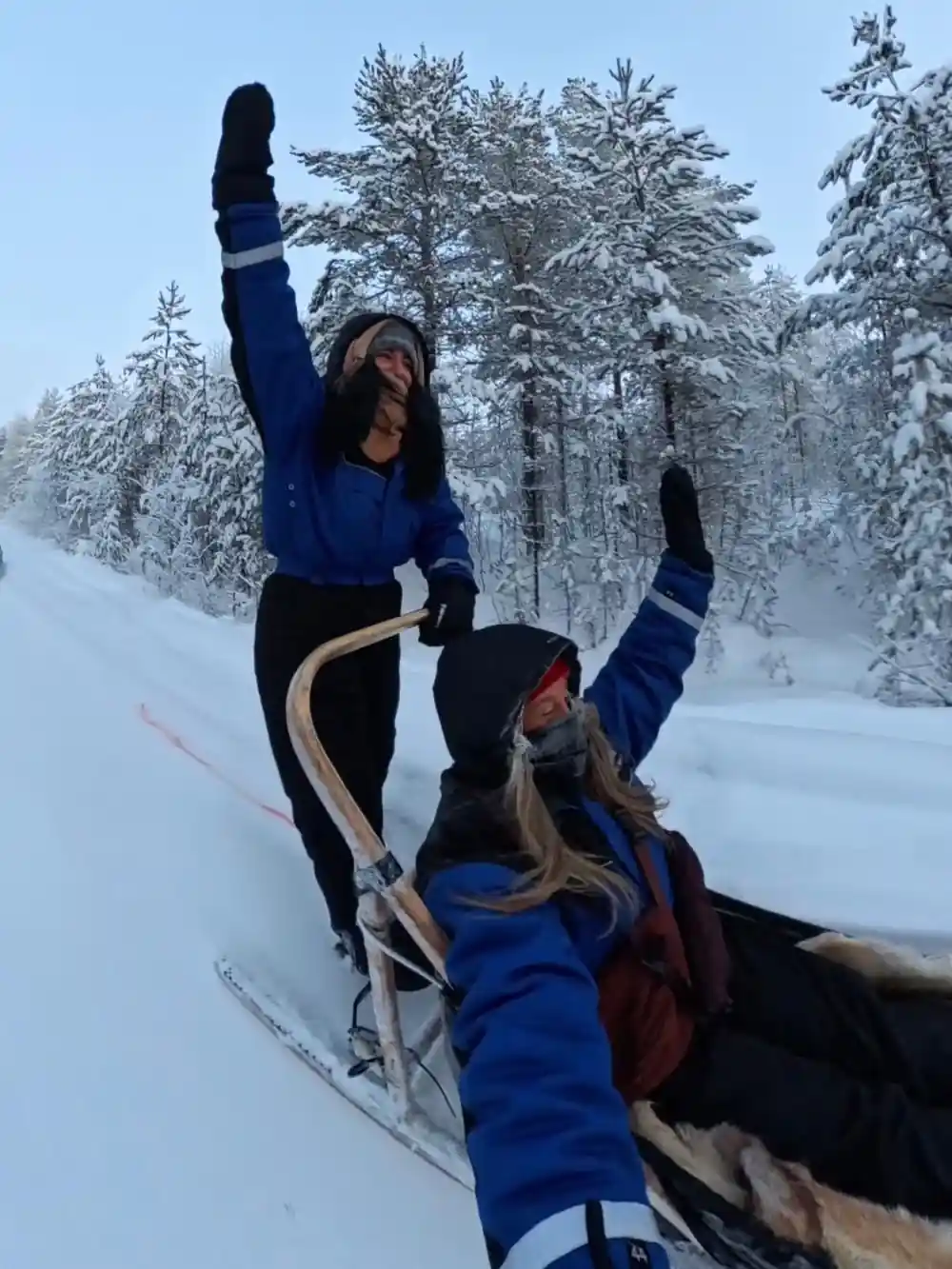
- You command your own team of huskies where the dogs know the way. No guide leads; you navigate the snow forest and frozen lake yourself.
- Experience the contrast of dense forest, open ice beneath your runners, and the particular quiet of the Arctic when the dogs settle into their stride.
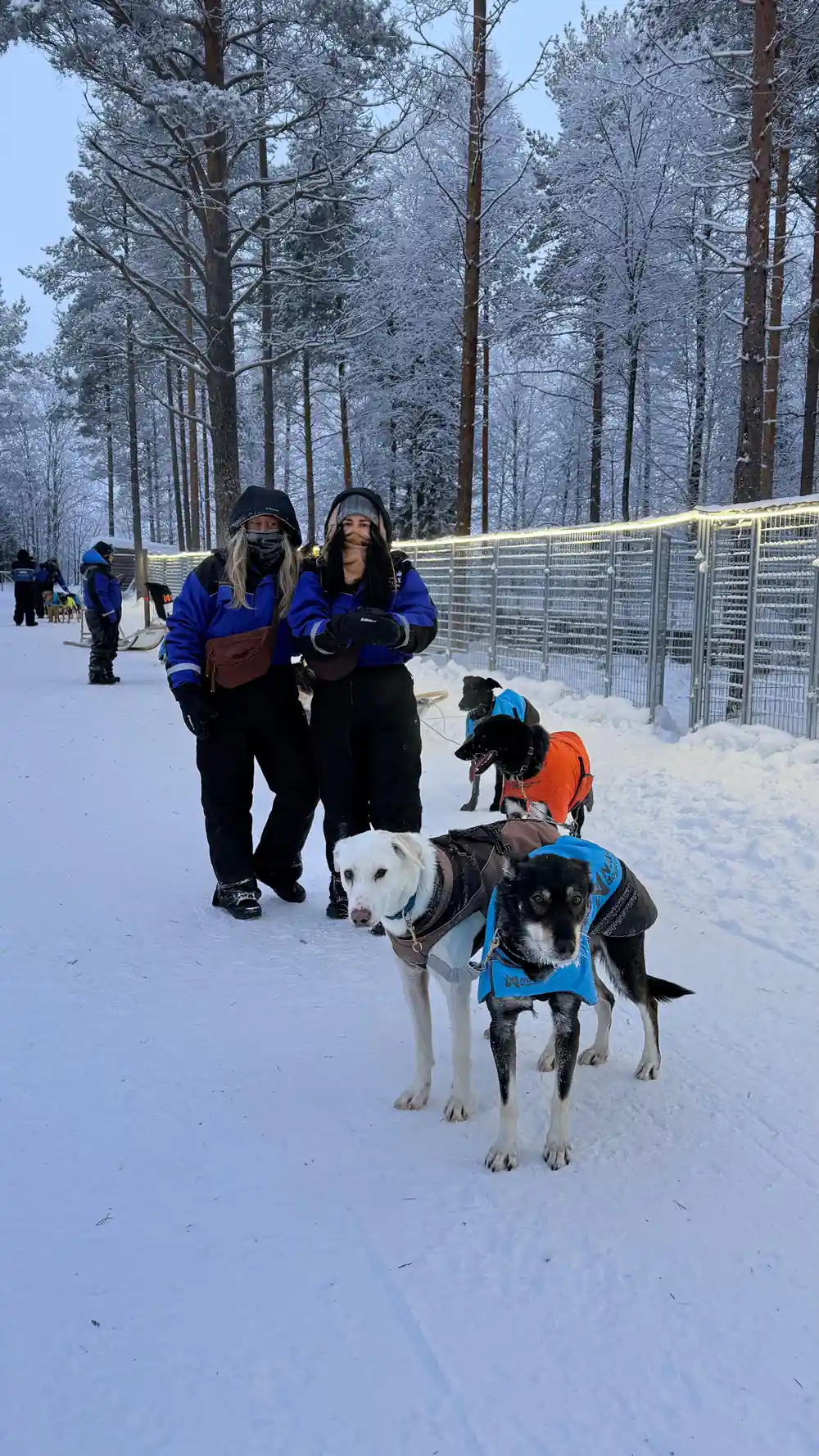
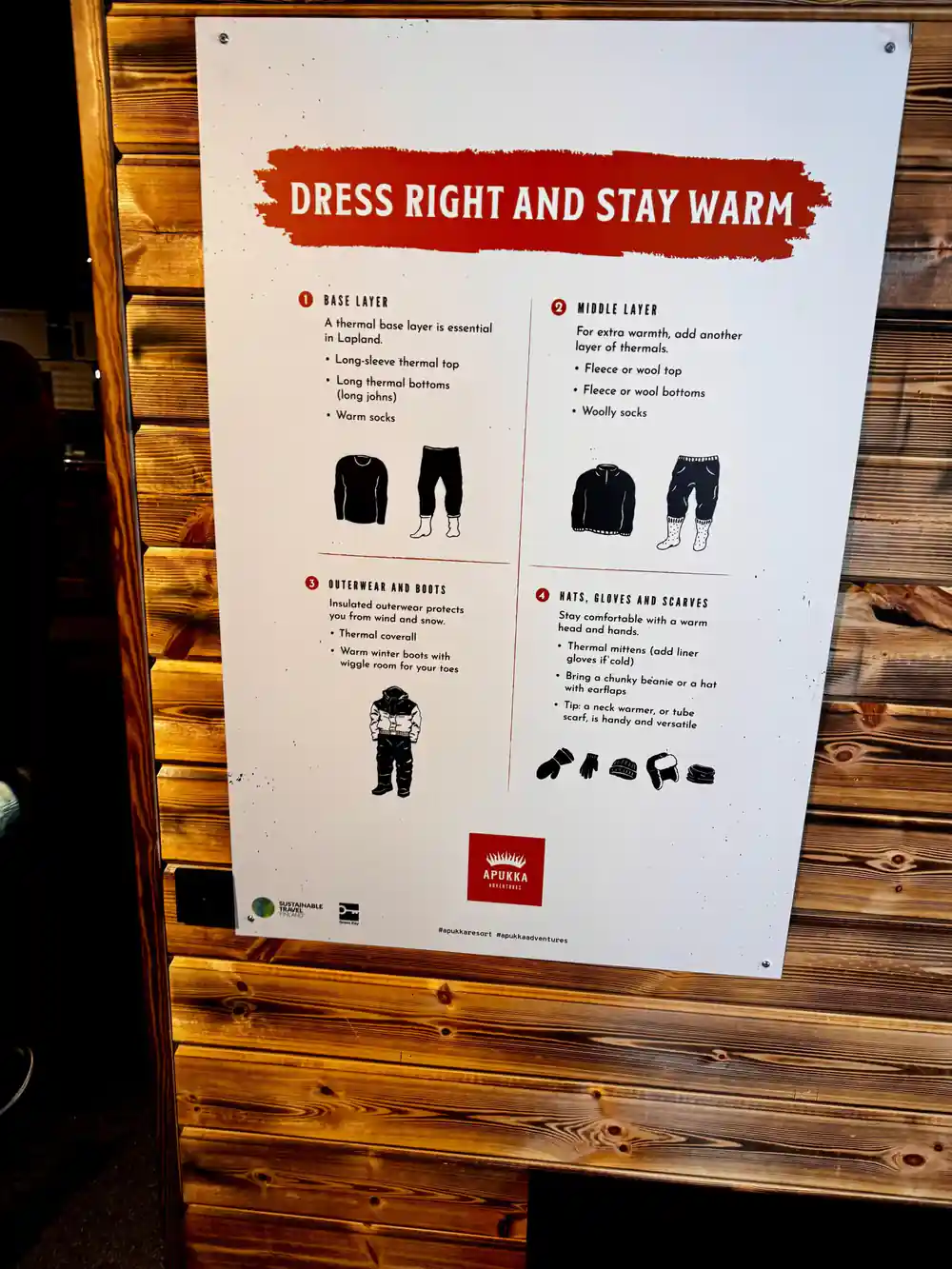
- Thermal clothing, winter boots, mittens and socks are provided. A hot drink warms you at Apukka, plus transfers from Rovaniemi city center if needed.
Through Snow Forest to the Ice
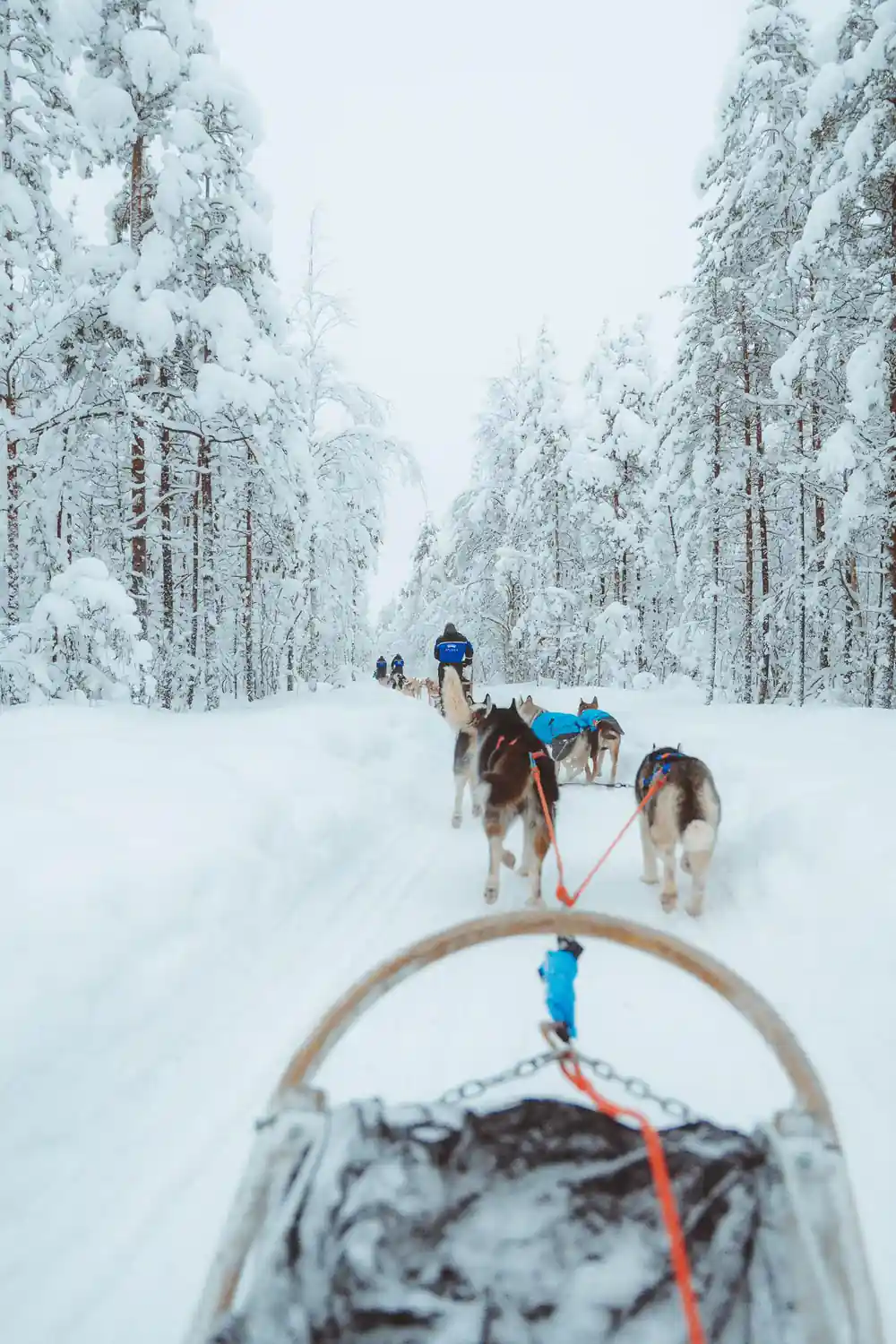
The six-kilometre route from Apukka begins where the kennel yard ends, at the boundary between managed forest and the working wilderness of Lappi. Your team of huskies pulls you into dense snow forest, where spruce and pine stand weighted under their winter coat. The forest floor disappears beneath snow that may be half a metre or more in depth by midwinter. The sled runners cut through this quiet landscape, and for the first two kilometres the route weaves between tree stands, following trails that open and narrow as the terrain dictates. This is not a manicured path but a genuine passage through boreal forest, where the only sound is the pad of paws, the creak of the sled, and the dogs' breathing.
The forest begins to thin as you approach the frozen lake. Before any team crosses onto ice, the thickness is checked rigorously. Finnish lake ice at the crossing point must reach a minimum of fifteen centimetres to bear the weight of a sled and team safely. By the time winter has progressed through January and February, ice depth often exceeds thirty centimetres. You will not step onto questionable ice. The transition from forest to open water is sudden and disorienting. The horizon widens, the wind finds you, and the silence deepens.
Lake Ice and the Frozen Landscape
Crossing a frozen lake in Finnish Lapland is not metaphor; it is a physical reality that changes how your body understands distance and direction. The ice beneath the sled is dark, sometimes grey, sometimes nearly black, and perfectly solid. The lake stretches unbroken to the tree line on the far shore, a sheet of snow-covered white punctuated only by your team's tracks and the occasional pressure ridge where ice has shifted with temperature change. The middle kilometres of your route run across this open expanse, and the wind that was absent in the forest becomes a presence. Your speed picks up here because the terrain is even and the dogs settle into rhythm.
The psychological effect of crossing a frozen lake should not be underestimated. Beneath the ice is water, and that knowledge, combined with the absolute flatness and the absence of landmarks, creates a peculiar focus. You are not distracted by scenery because the scenery is featureless. The dogs know this route. They have run it dozens of times. Your job is to stay upright on the sled, to keep the reins steady, and to let them work.
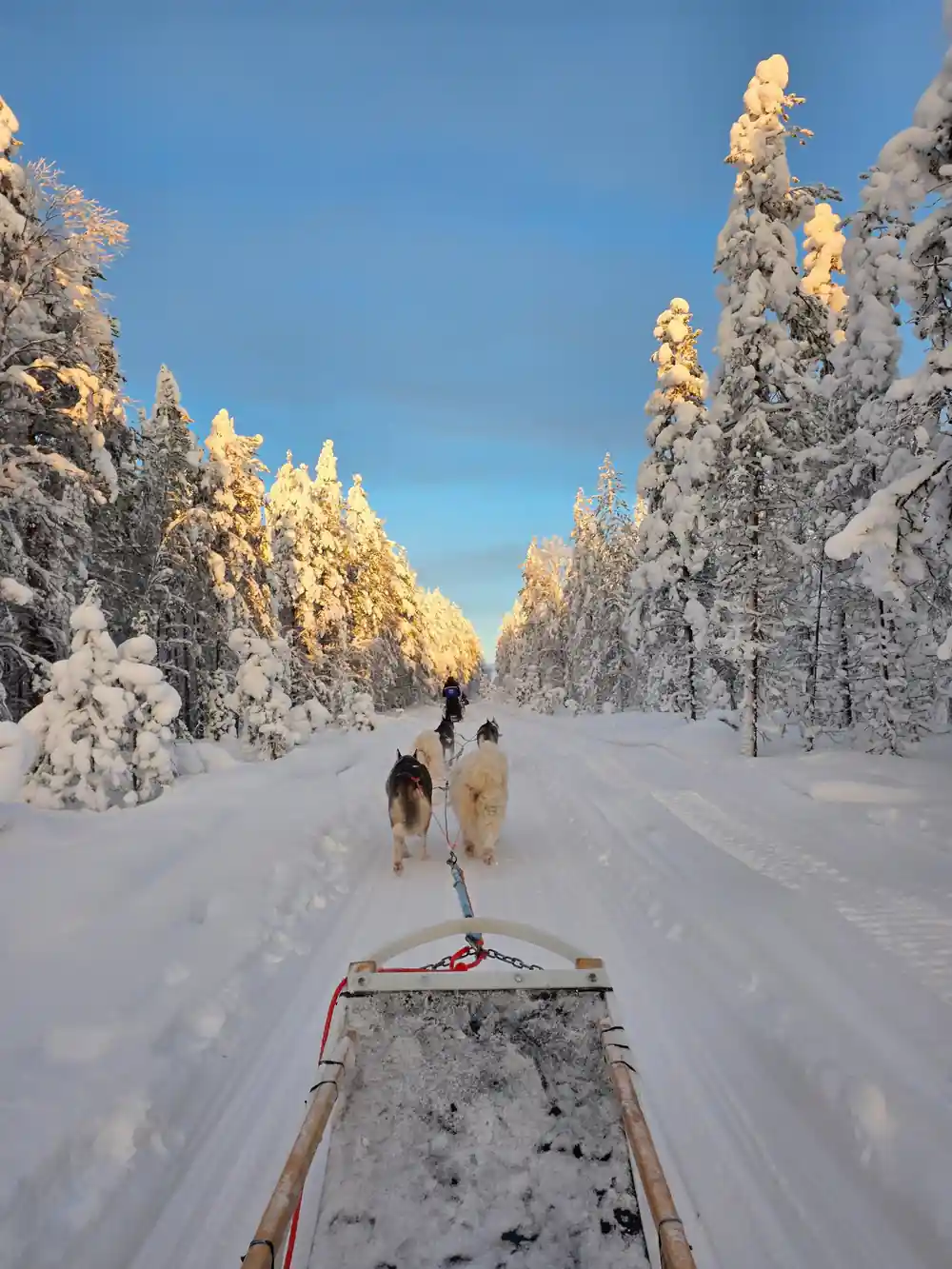
Silence spreads across the ice as the team finds its rhythm
Tykky Spruce and the Return to Forest
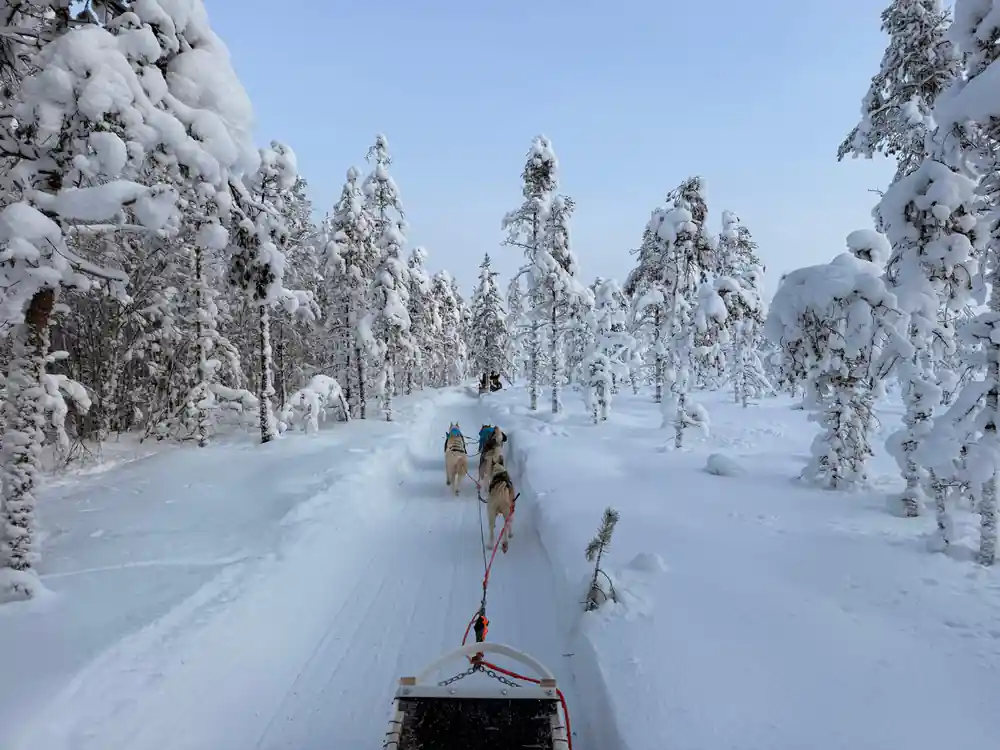
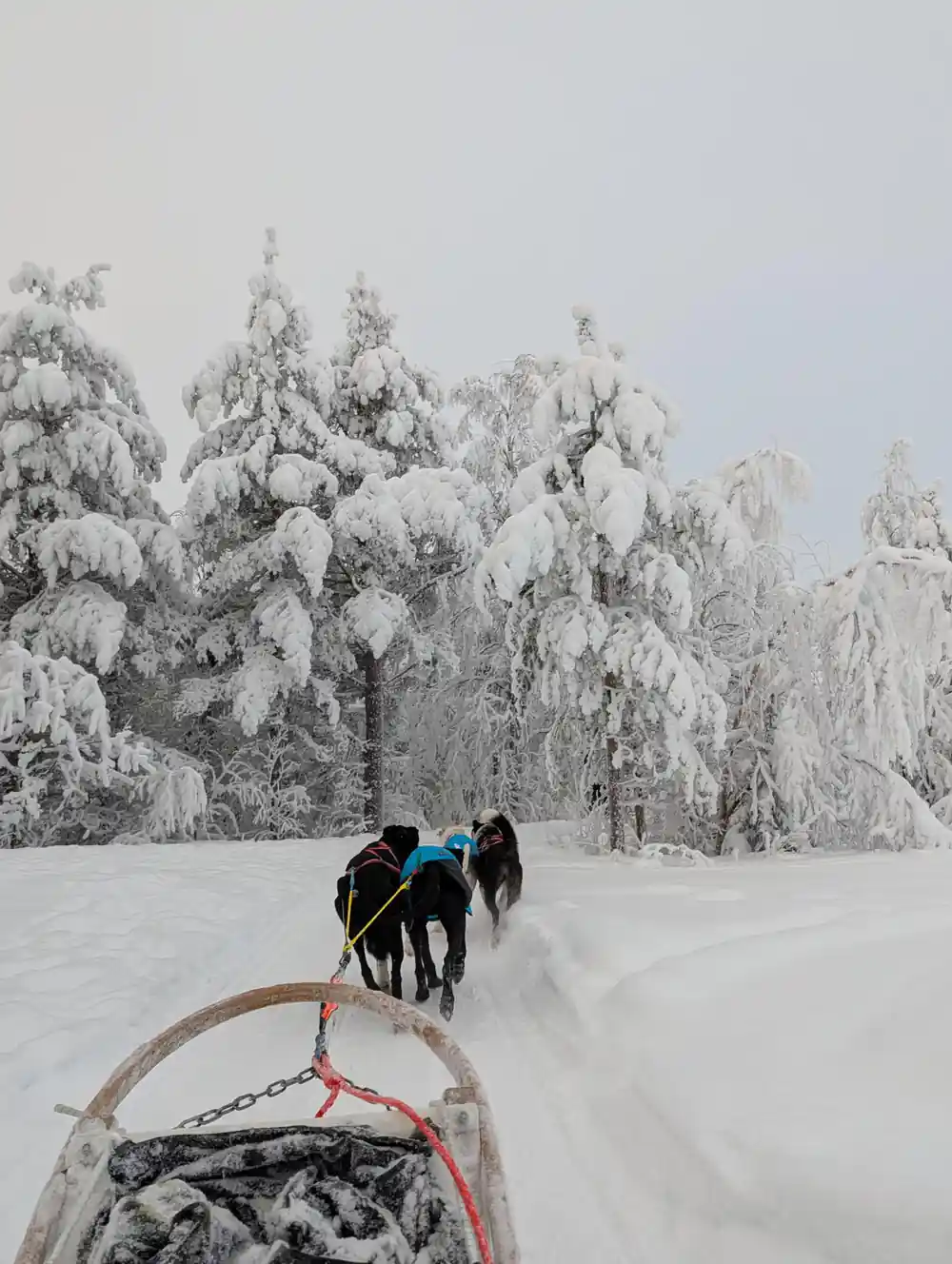
As the route turns back toward shore, you re-enter forest, but this is not the forest you left. The trees here are laden with tykky, the heavy rime that accumulates when fine snow crystallises directly onto branches and needles in extreme cold. A tykky spruce is transformed into something that looks almost artificial, its outline softened and fattened by the white coating. These trees stand in loose ranks beside the trail, and in strong winter light they glow. The weight they carry is considerable, sometimes so heavy that branches bend or break, but they endure. Tykky forms in temperatures below minus ten degrees Celsius and in particular moisture conditions. It is not ordinary frost. It is the signature of deep Lapland winter.
The sled navigates between these transformed trees with the same confidence it showed on the lake. The dogs slow slightly as terrain rises and falls, as snow depth varies, and as the forest closes around you again. This section of the route is where many runners find themselves most alert to their surroundings, because the trees are beautiful in a way that feels temporary, and because you are no longer in the open.
The Moment Silence Arrives
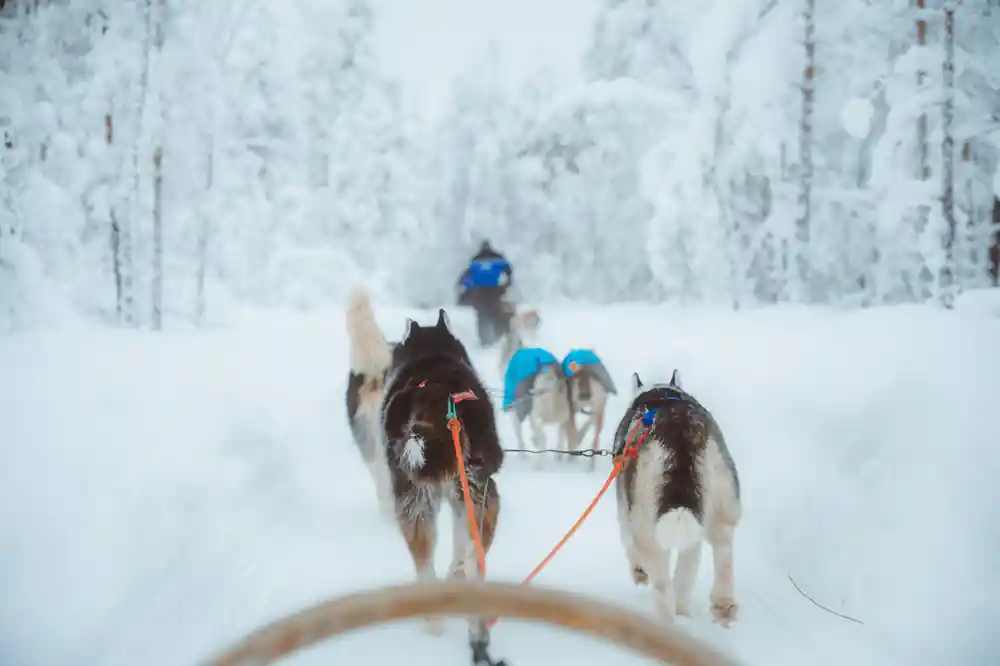
Roughly four kilometres into your journey, there is a point where something shifts. The dogs, having worked steadily, settle into such an efficient rhythm that their effort becomes almost invisible. The urgency leaves their movements. Their breathing, which sounded laboured near the start, becomes steady and calm. At this moment, the soundscape changes completely. You stop hearing the individual components of the sled's operation. The wind, which was evident on the lake, is filtered by forest. The only sound remaining is the soft compression of snow under paws, the faint clink of harness metal, and eventually, your own breathing.
This is Arctic silence, and it is not the absence of sound but a quality of quietness so complete that it seems to have weight. It cannot be replicated elsewhere. It is specific to this latitude, this time of year, this depth of winter. Experienced runners describe it as meditative, even spiritual. It arrives reliably on every run, usually at the same point in the route, once the team has settled and the landscape has absorbed all external noise. This silence is not interruption. It is the purpose of the journey.
Wildlife of the Winter Forest
The Lapland forest through which your route passes is not empty. Although you may not see them, the landscape supports populations of species adapted to extreme cold. Red foxes inhabit these forests and sometimes follow sled routes from a distance, drawn by the disturbance and opportunity. Pine marten move through the branches. Reindeer herds, managed by Sámi herders, occupy broader territories. In the forest canopy, birds including willow grouse and Siberian jay persist through winter by exploiting seed sources and managing their temperature precisely. Under the snow, small rodents create tunnel systems and survive on stored food and plant material.
The frozen lake also supports life. The ice fishermen who cut holes through the ice pursue species including perch and pike that live in the water below. This entire ecosystem, forest and water together, operates on principles of extreme efficiency and conservation. The dogs running through it are apex predators of their environment, and their presence, their scent, and their sound send ripples of disturbance through this quiet world. Most of the wildlife you pass remains unseen.
Why Six Kilometres is the Right Distance
A six-dog team at Apukka can hold a good pace far longer than this route asks of it; the whole outing runs 3 hours 30, of which the sled itself takes about half an hour. The six-kilometre run itself takes roughly half an hour, a little more or less depending on conditions and the team's mood on the day. This distance was selected not arbitrarily but through years of operation. It is long enough to be a genuine adventure, to cross multiple terrain types, to spend meaningful time on the ice, and to experience the Arctic silence at its fullest. It is short enough that the dogs finish the run willing and fit, not exhausted.
The sled speed over six kilometres typically averages between ten and fifteen kilometres per hour, brisk but not the gallop many people expect. This is not a sport of velocity but of presence and endurance. Six kilometres allows the team to warm up through the first forest section, hit stride on the lake, and return through the tykky-laden spruce without degradation in performance. It is the distance where a runner can relax into the sled, where the dogs can relax into their work, and where the landscape reveals itself fully. Longer distances would risk fatiguing the team unnecessarily. Shorter distances would not reach the moment when silence truly arrives.
What to Expect on Your Run
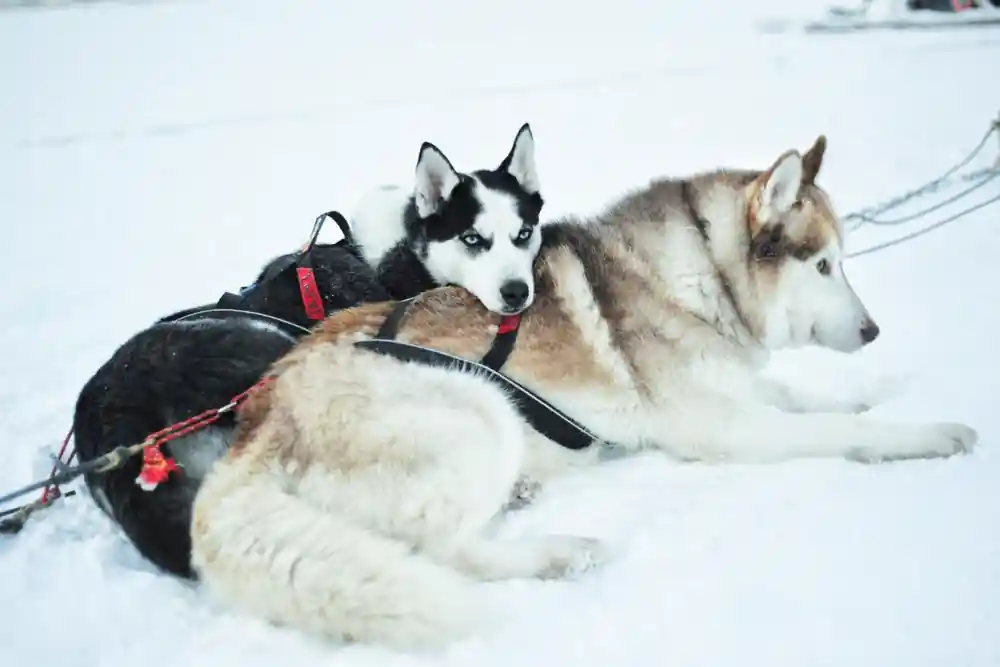
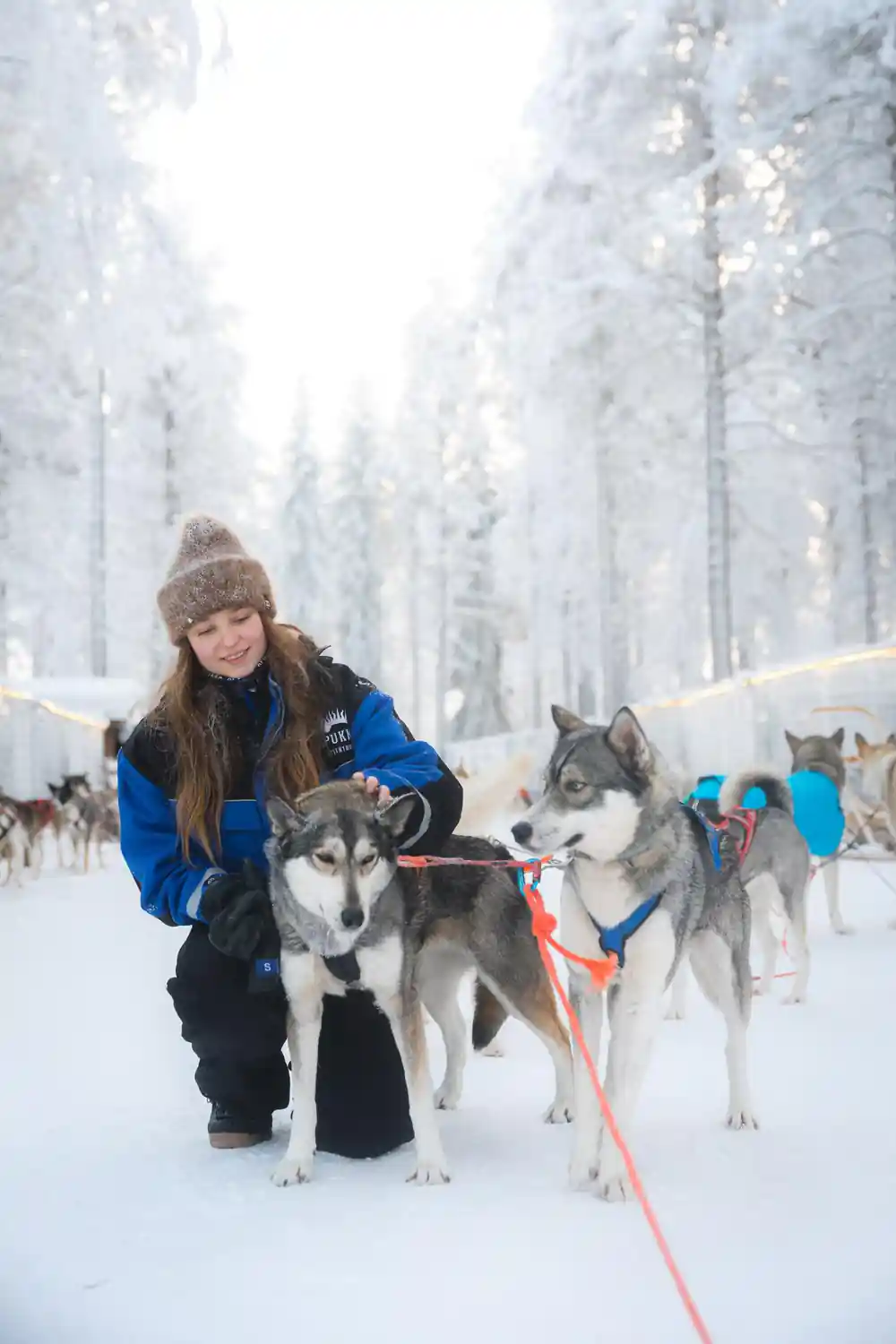
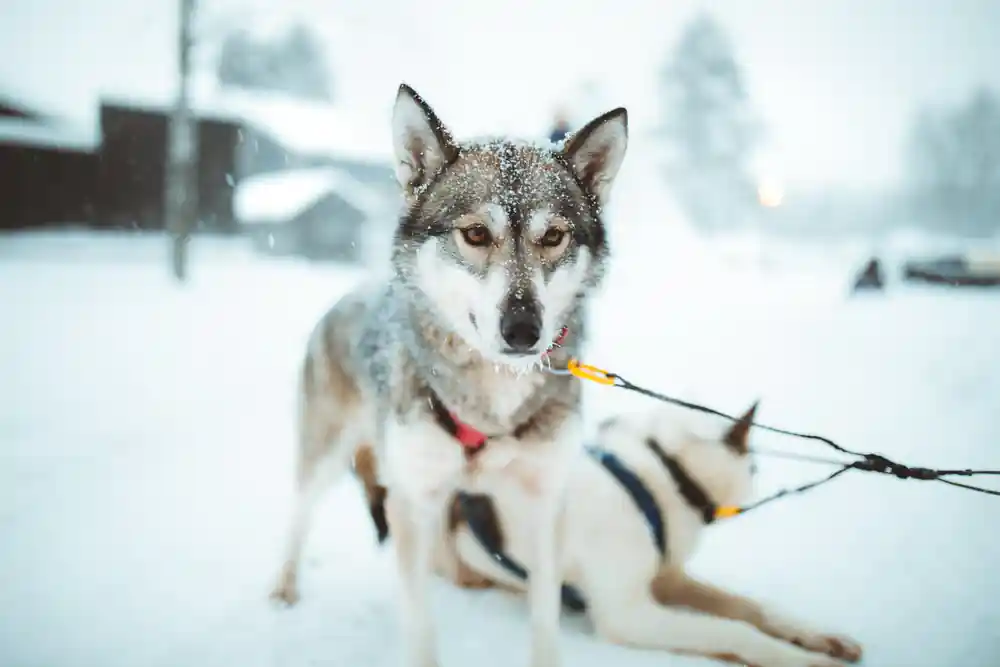
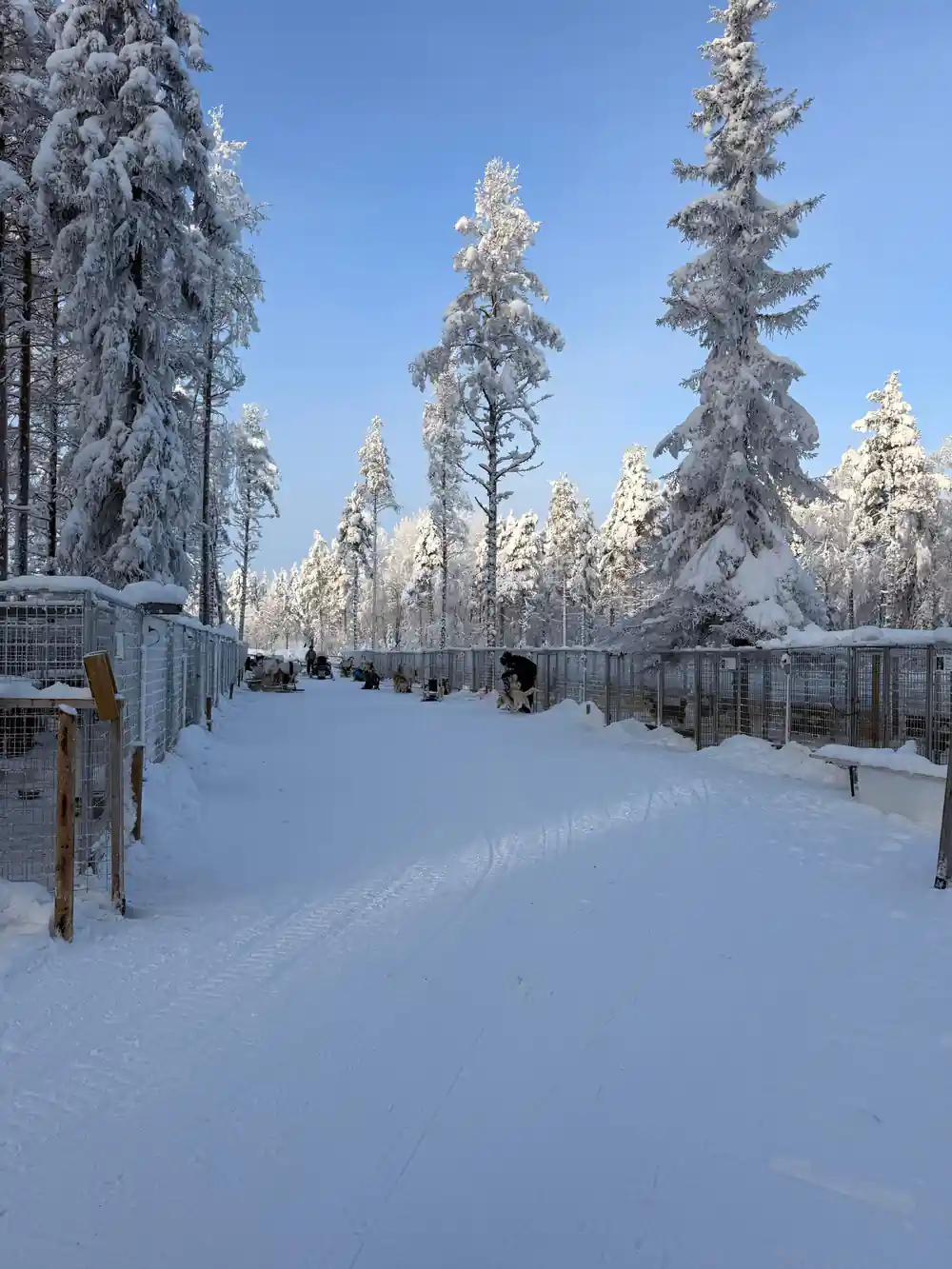
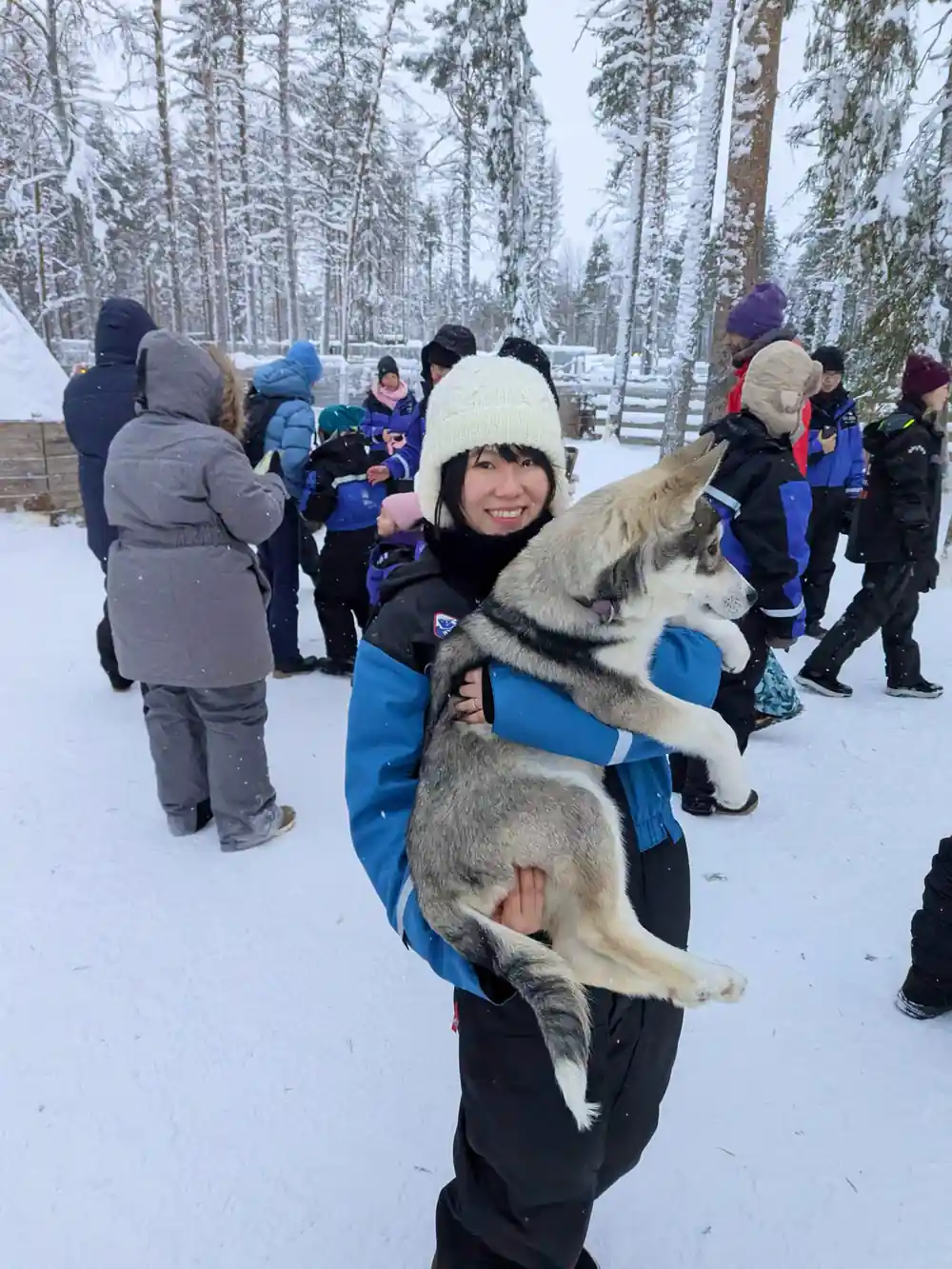
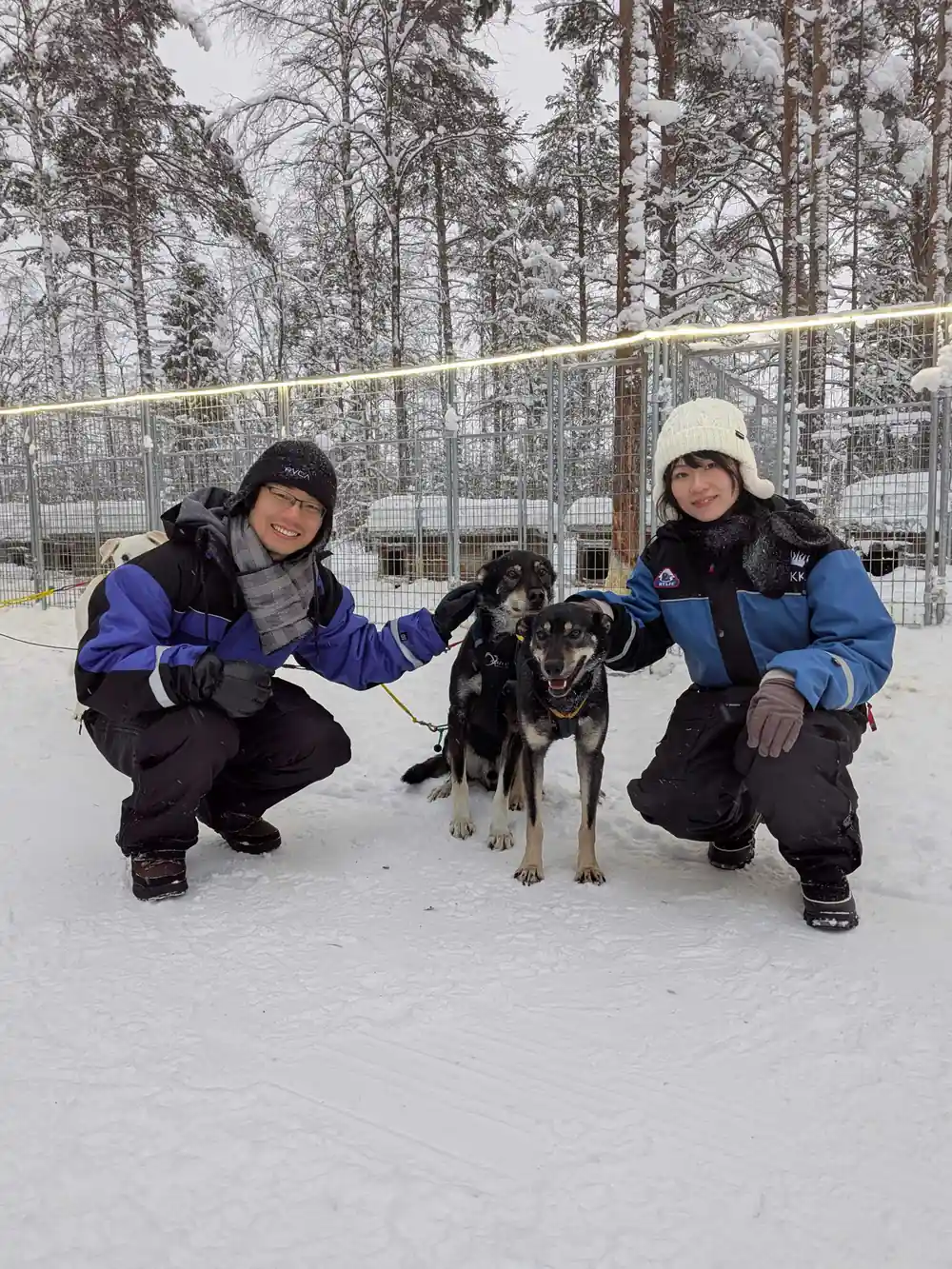
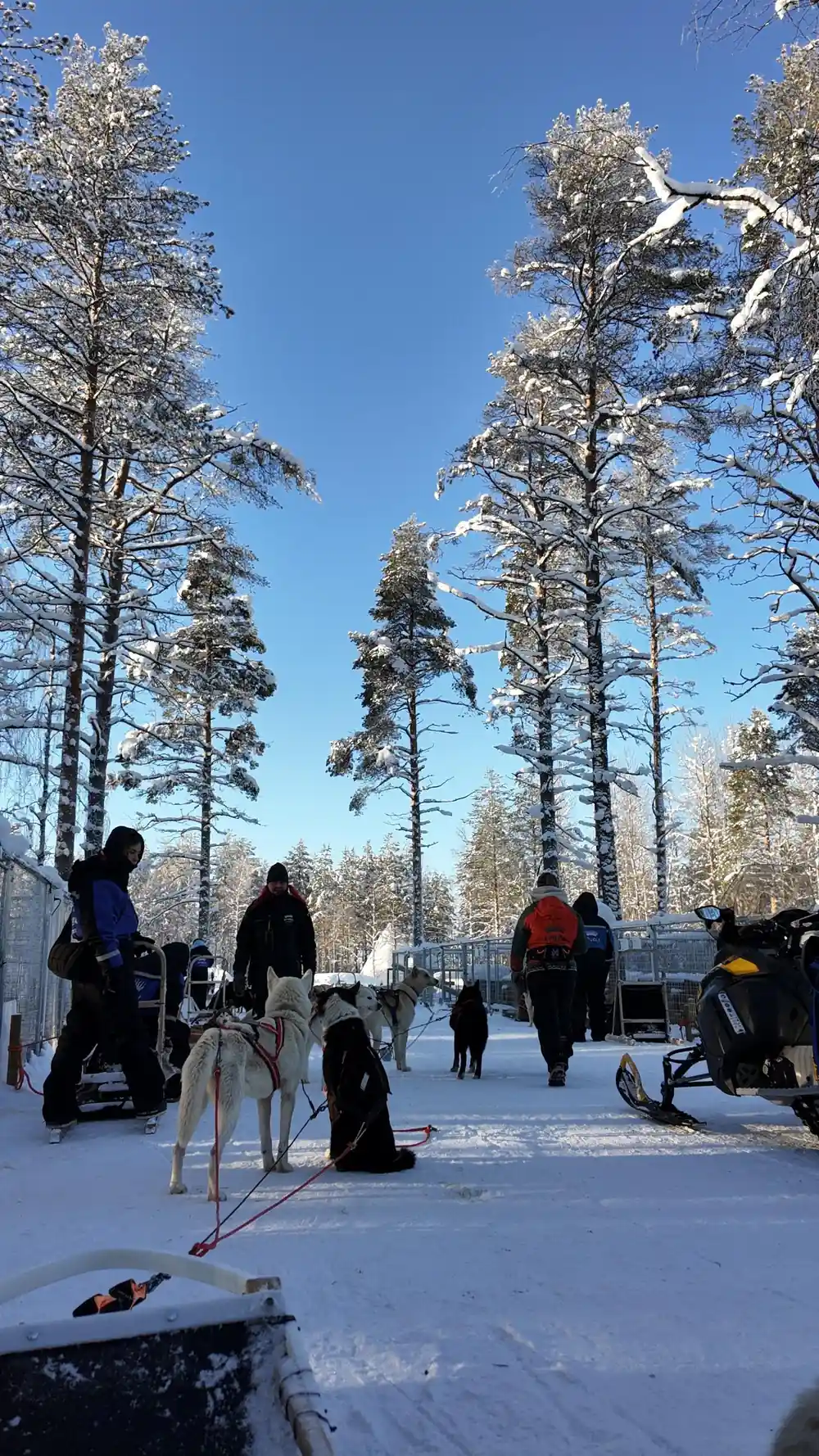
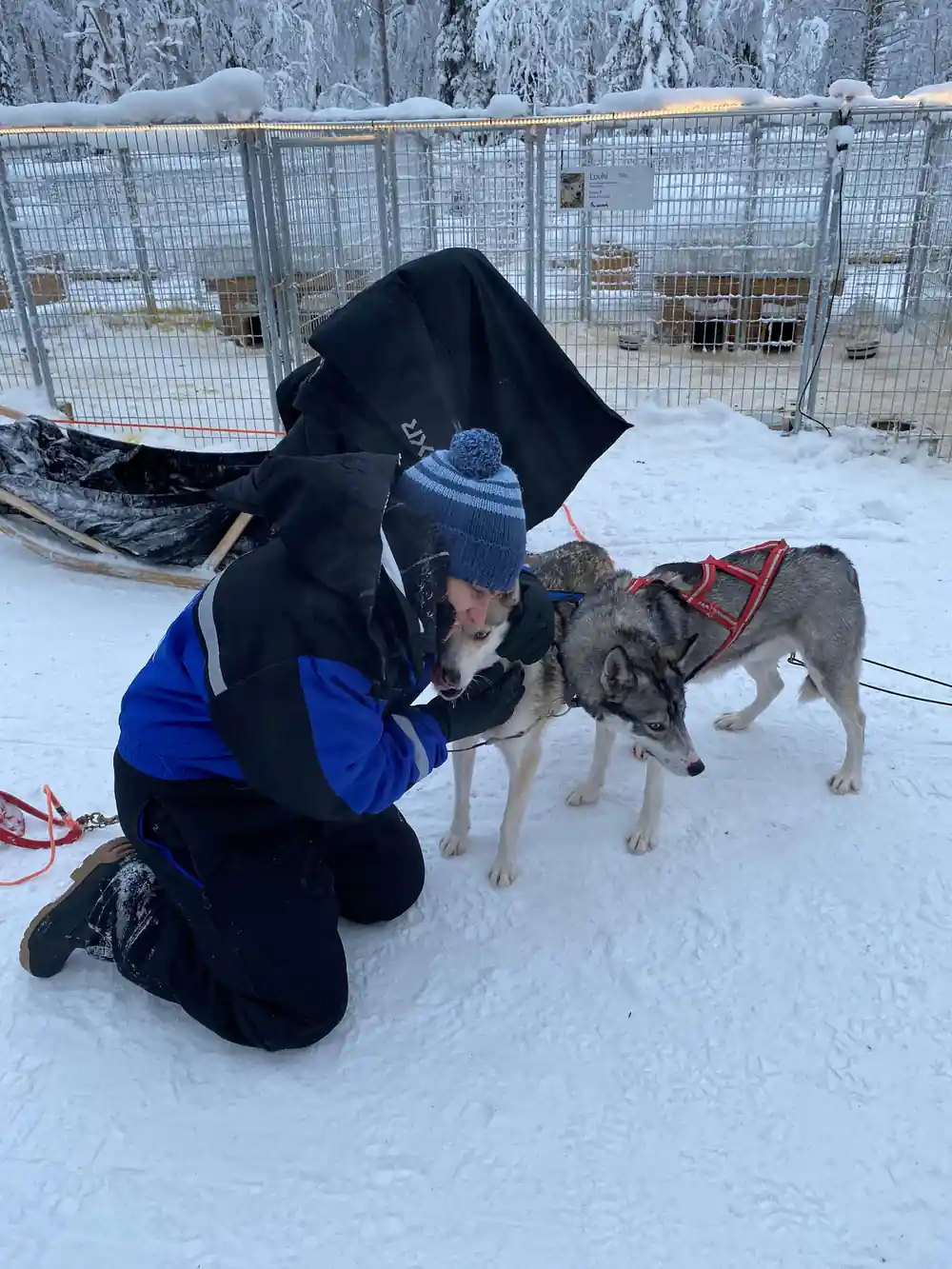
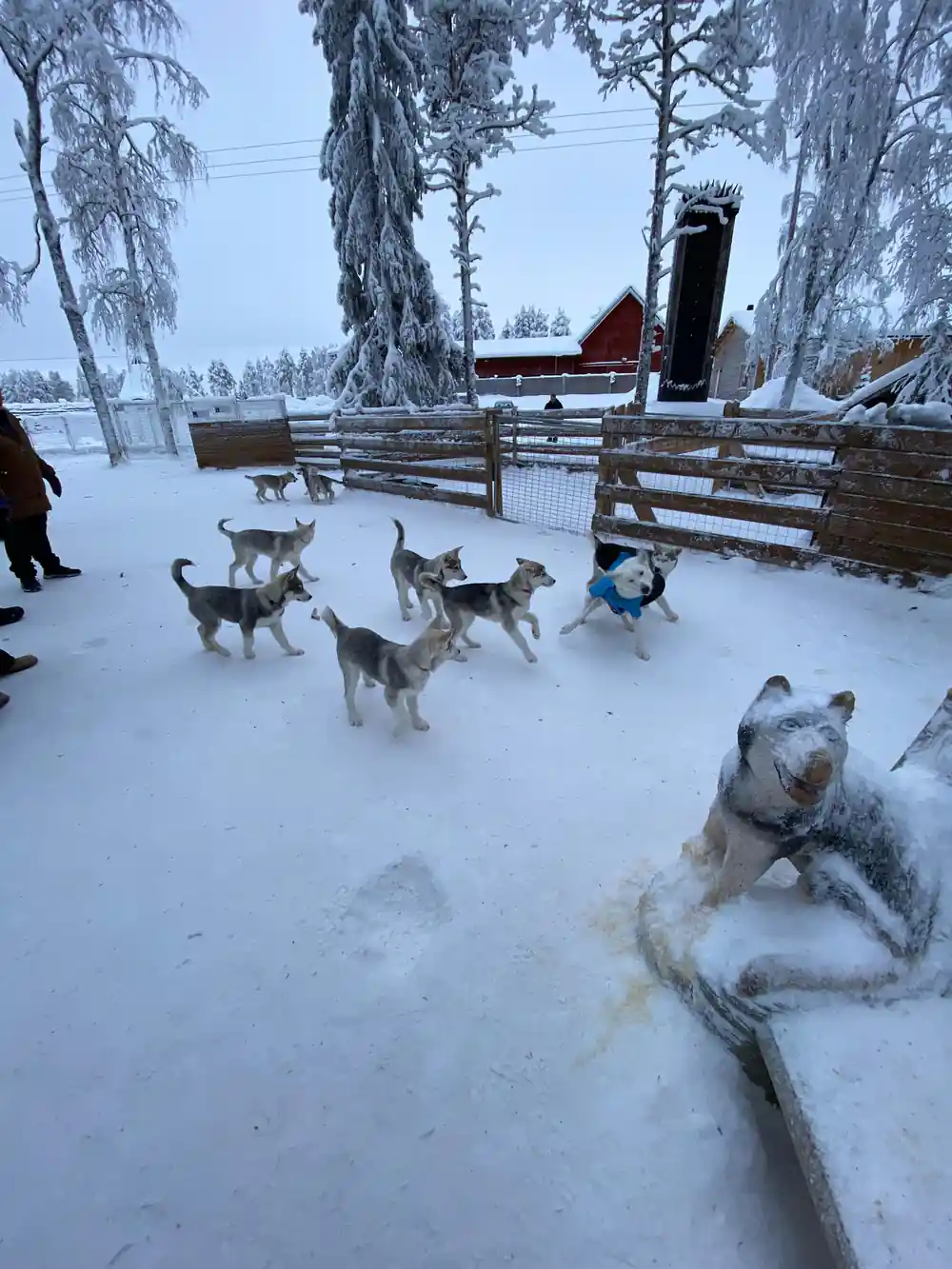
Your experience begins at the Apukka facility in Finland, where you receive instruction in sled operation and handling, and where you meet your team. You will dress in provided thermal clothing, designed for the specific conditions of a Lapland winter. The dogs are accustomed to runners of varied experience levels. They respond to consistent weight distribution and calm hands on the reins. Your guides understand the route intimately, know how to read the dogs' behaviour, and can adjust the day's plans if weather deteriorates or if conditions demand it.
As you complete the route and return to base, you will have run dogs, crossed a frozen lake, navigated a forest transformed by tykky, and experienced the deepest quiet that winter offers. This is not spectacle. It is not entertainment in the conventional sense. It is an encounter with a landscape and a way of living that has persisted in Lappi for centuries, and with a team of animals bred and trained for precisely this work. The three-hour-and-thirty-minute outing, with the six-kilometre run at its centre, is designed to give you the fullest possible version of that encounter.
Your own team waits on frozen ice
from US$253Reserve now & pay later